
If you’ve ever published a blog post but didn’t see it ranking on Google, you’re not alone. Many websites struggle because they ignore one critical part of SEO — on page SEO techniques.
The truth is simple: no matter how good your content is, if it’s not optimized properly, search engines won’t understand it — and users won’t stay long enough to engage.
In this guide, you’ll learn the real purpose of on page SEO techniques, how they work, and how you can apply them step-by-step to improve rankings, traffic, and conversions.
What Are On Page SEO Techniques?
On page SEO techniques refer to all the optimization strategies you apply directly on your website pages to improve their visibility in search engines.
This includes:
- Optimizing content with the right keywords
- Improving titles and meta descriptions
- Structuring headings properly
- Enhancing user experience (UX)
- Optimizing images and page speed
In simple terms, it’s about making your content search engine-friendly and user-friendly at the same time.
What is the Purpose of On Page SEO Techniques?
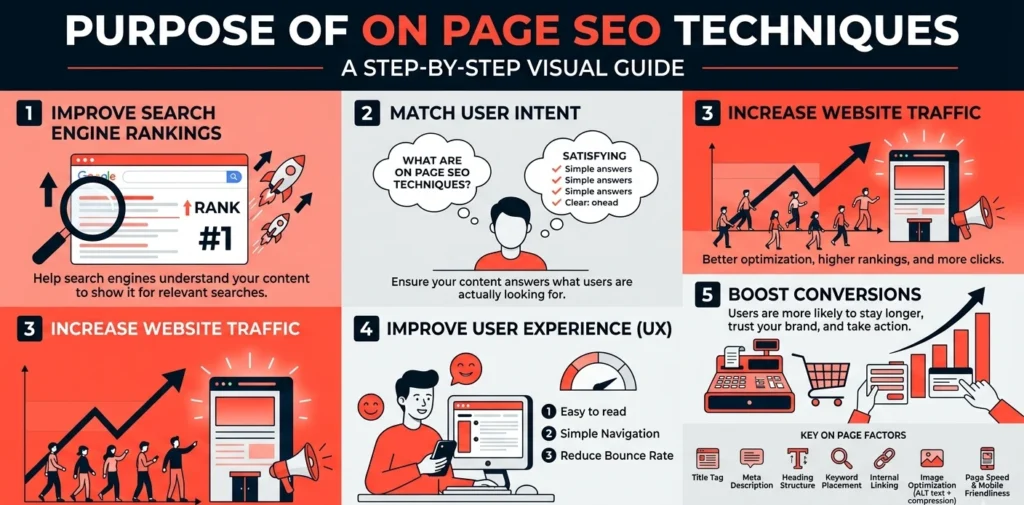
The main purpose of on page SEO techniques is to help search engines understand your content and rank it higher for relevant searches.
Let’s break it down into practical benefits:
-
Improve Search Engine Rankings
When you use proper on page SEO factors, Google can easily understand what your page is about and show it to the right audience.
👉 Example:
If your blog is optimized for “on page SEO techniques,” Google will rank it for users searching for that term.
-
Match User Intent
Modern SEO is not just about keywords — it’s about intent.
On page SEO ensures your content answers what users are actually looking for.
👉 Example:
If someone searches “what are on page SEO techniques,” they expect a clear explanation — not a sales pitch.
-
Increase Website Traffic
Better optimization = higher rankings = more clicks.
By using on page SEO techniques in digital marketing, you can attract consistent organic traffic without paying for ads.
-
Improve User Experience (UX)
Good SEO is not just for search engines — it’s for people.
On page optimization techniques help you:
- Make content easy to read
- Improve navigation
- Reduce bounce rate
-
Boost Conversions
When users find your content helpful and easy to understand, they’re more likely to:
- Stay longer
- Trust your brand
- Take action (buy, sign up, contact)
Key On Page SEO Factors You Must Focus On
To understand the purpose better, you need to know what actually impacts your SEO.
Important on page SEO factors:
- Title Tag Optimization (include main keyword)
- Meta Description (improves click-through rate)
- Heading Structure (H1, H2, H3)
- Keyword Placement (natural usage)
- Internal Linking
- Image Optimization (ALT text + compression)
- Page Speed & Mobile Friendliness
These elements together form strong on page optimization techniques.
Step-by-Step On Page SEO Checklist (Actionable)
Here’s a practical checklist you can apply immediately:
Keyword Research
- Find a primary keyword (e.g., on page SEO techniques)
- Add related keywords naturally
Optimize Title & Meta Description
- Include your main keyword in the title
- Keep it engaging to improve CTR
Use Proper Heading Structure
- One H1 (main title)
- Use H2 and H3 for sections
Write High-Quality Content
- Solve a real problem
- Use simple language
- Add examples
Optimize Images
- Use compressed images
- Add descriptive ALT text
Add Internal Links
Link to relevant pages like this helpful guide:
👉 Complete SEO Guide for Beginners (2026) – Step-by-Step
Improve Page Speed
- Use fast hosting
- Minimize code
- Enable caching
Real-Life Example
Let’s say you wrote a blog about “digital marketing tips.”
Without on page SEO:
- No proper keywords
- No headings
- Slow loading
👉 Result: No ranking
With on page SEO techniques:
- Proper keyword placement
- Optimized headings
- Fast loading
👉 Result: Higher ranking + more traffic
Testimonials
“After implementing these on page SEO techniques, our website traffic grew by over 70% in just one month.” – Usman Tariq
“Once we improved our content structure and SEO elements, our rankings started climbing for even competitive keywords.” – Hira Siddiqui
“Optimizing our pages properly helped reduce bounce rate and significantly increase our leads.” – Bilal Ahmed
People Also Ask (PAA)
- What are on page SEO techniques?
On page SEO techniques are methods used to optimize website pages for better search engine rankings and user experience.
- Why are on page SEO techniques important?
They help search engines understand your content and improve your chances of ranking higher on Google.
- How do on page SEO techniques improve rankings?
By optimizing content, keywords, and technical elements, they make your page more relevant and valuable to users.
- What are the most important on page SEO factors?
Key factors include title tags, meta descriptions, content quality, internal linking, and page speed.
- How long does on page SEO take to work?
You can start seeing improvements within a few weeks, but consistent results usually take 1–3 months.
Common Mistakes to Avoid
Avoid these common errors:
- Keyword stuffing (overusing keywords)
- Ignoring user intent
- Poor heading structure
- Slow website speed
- Not optimizing images
Conclusion
The purpose of on-page SEO techniques is simple but powerful:
👉 Help search engines understand your content
👉 Improve user experience
👉 Increase rankings, traffic, and conversions
If you apply the strategies shared in this guide, you’ll see real improvements in your website performance.
🚀 Want faster results?
WebZonic Agency offers professional SEO services to help your business rank higher, attract more traffic, and grow online. Get in touch today and take your website to the next level.
Author Bio
Written by Muhammad Taha, an SEO Specialist at WebZonic Agency, helping businesses grow their online presence through effective SEO and digital marketing strategies.
One Response
Yes you wrote this blog perfectly because some people don’t know how to fix on page issues. Meta tags, internal links and heading structures are the important things to fix.